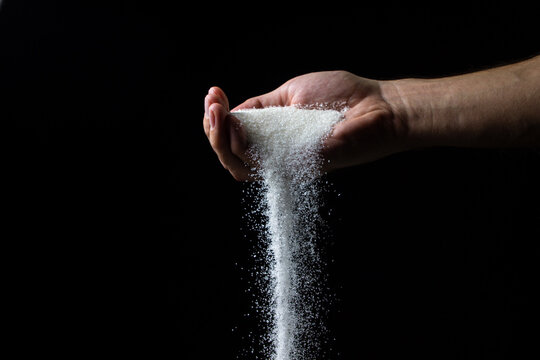
Choose carefully.
Sugar is sweet. Not all sugars share the same sweetness. Their structures vary; they bind differently to taste receptors, creating different perceptions as nerve signals travel from tongue to brain. Sugar has a high melting point and serves many purposes: sweetness, texture, color, flavor formation, preservation, fermentation.
Pour some sugah on me.
Salt is bitter. Too much salt leaves a distinct aftertaste. Too much salt ruins the dish. Too much salt kills what grows in the garden; what comes from the earth.
For those who favor biblical metaphor, salt appears often—used to signify permanence, loyalty, durability, fidelity, usefulness, value, purification.
Salt of the earth and all that.
But as you will read, I beg to differ. Salt is bitter. Too much of it lingers. Too much of it ruins what might have otherwise been good. Real salt of the earth is the opposite of real salt.
Sugar and salt are both white. Sugar crystals are larger, more translucent; salt is more opaque, a little darker. Still, they look nearly the same.
Until you learn they are vastly different in the game of life.
You can keep dipping your spoon into the sugar bowl, learning to balance sweetness with the raw and the unrefined. Or you can fool yourself—again and again—into believing salt can become sugar.
Water into wine is one thing, I suppose.
Salt will never become sugar.
Nope.
Any chef or baker will tell you: one cannot substitute for the other.
And this has been the lesson.
One of the longest, hardest lessons of my life.
I believed sugar—a shake, a spoonful—could balance out the salt.
Growing up, my Grandma Brown would add just a dash of sugar to her collard greens if they cooked down too bitter, even with salty fatback simmering in the pot.
Needs some sugah, she’d say.
And then there was Hattie White. While my mother worked the graveyard shift at the hospital and my father completed his residency and taught classes, Hattie was the soul—and I mean heart and soul—who cared for me and my brothers. She was the truest definition of salt of the earth. And she had just enough sugar to heal, protect, nourish, teach, and help us survive. Thrive. She was family. Hattie died exactly a year and a day after my mother died, as if to stick around a little bit longer to make sure we, even as adults were okay.
It was Hattie who first said to me after I accidentally sprinkled salt on my bowl of cereal:
Sugar and salt look the same. Choose carefully.
I was 7.
My high school creative writing teacher said the same thing when I wrote about moments where I hadn’t chosen carefully.
I didn’t know any better.
My college professor and mentor repeated it as I sat in her office crying over injustice, frustration, the cruelty of the world, the hatred of the unhealed, the fractures in my family.
It’s a blind test, she’d say. Sometimes the sugar bowl and the salt pot look the same. Use your intuition. Trust yourself enough to know. And honey, she said, drawing out the word honey in her distinct southern drawl, sometimes you won’t know the difference until you’ve taken a bite outta what’s in front of you.
And there I was thinking it was already hard enough kissing frogs to find a prince.
It has taken years to trust enough to know. Years. You could say the sugar and salt lesson has been the seasoning sprinkled throughout various chapters of my life.
Forgive the blatant indulgence use of metaphor.
And if the last several months have taught me anything, it is this: you cannot change the chemical compound of salt with a heaping dose of sugar. There are many times when the spoonful of sugar does not help the medicine go down. The bitterness of salt is inherent. It cannot be transformed.
By now, you catch the gist of the drift. I am not talking about seasoning.
This is about people.
People I thought were sugar-coated. Maybe a little raw, unrefined, unhealed, walking on uneven ground. They just needed more time. I tolerated them. I allowed them grace. Even when my intuition was yammering away. I did not trust my intuition. I did not trust what I already knew. My intuition was damn near screaming at me. And I did not listen.
I ignored those who had been burned by the same salty covered people. Even when they warned me to watch my back. And I did not listen.
I held out for the good.
If you believe a lesson repeats until it is learned, good riddance to this one.
I have learned. I am done.
Over the past few months, I have felt the burn of people—mostly women—who harmed, accused, lied, covered their tracks and spilled their unhealedness everywhere. They went a little heavy with the salt. One of them cost me a job I loved. Her bitterness could not accept anything beyond her limited point of view, so she poured salt over everything until nothing good remained.
I believed I could make a difference. I believed I could sweeten what was dark and broken.
I was wrong. Boy was I wrong.
Sometimes salt wins. Sometimes the bitterness in people cannot be fixed. You realize you were not the only one in their path—just the most recent.
These women will embezzle. Lie. Perform and proclaim righteousness. Weaponize social media. Hurt without leaving visible marks though the damage is real. They will invent their own truth to cover their own lies, manufacture complaints, steal your ideas and call them their own, tell you to ignore what you see, even when others are in crisis, manipulate young people into revealing their darkest secrets under the guise of a “truth circle” and demand that you stop pointing out what is right.What is not right. What is true.
They will tell you to stop being you.
They will smile in meetings and sharpen the knife in an email.
They smile a crooked smile while pouring salt on the wound they created.
So you tend to the wound ensuring it heals clean, watching for infection. It may leave a scar, but you remain unruined.
The swords you chose to fall on did not destroy what keeps you going. What keeps you alive. What keeps you intact.
The swords made you more cautious. Still standing. Still here.
I tolerated too much.
It feels funny writing this at my age. Maybe I was naive for far too long.Foolish even.
But it is true.
Despite the anger.
Despite the hurt.
It has taken me a long time to learn this lesson. I sit here still bewildered, still angry, still grieving the injustice; the loss of something I loved, the lack of accountability, still stunned by the need some women have to be cruel and destructive.
I cannot change this.
But I can change how I see salt. And sugar.
And I choose carefully.